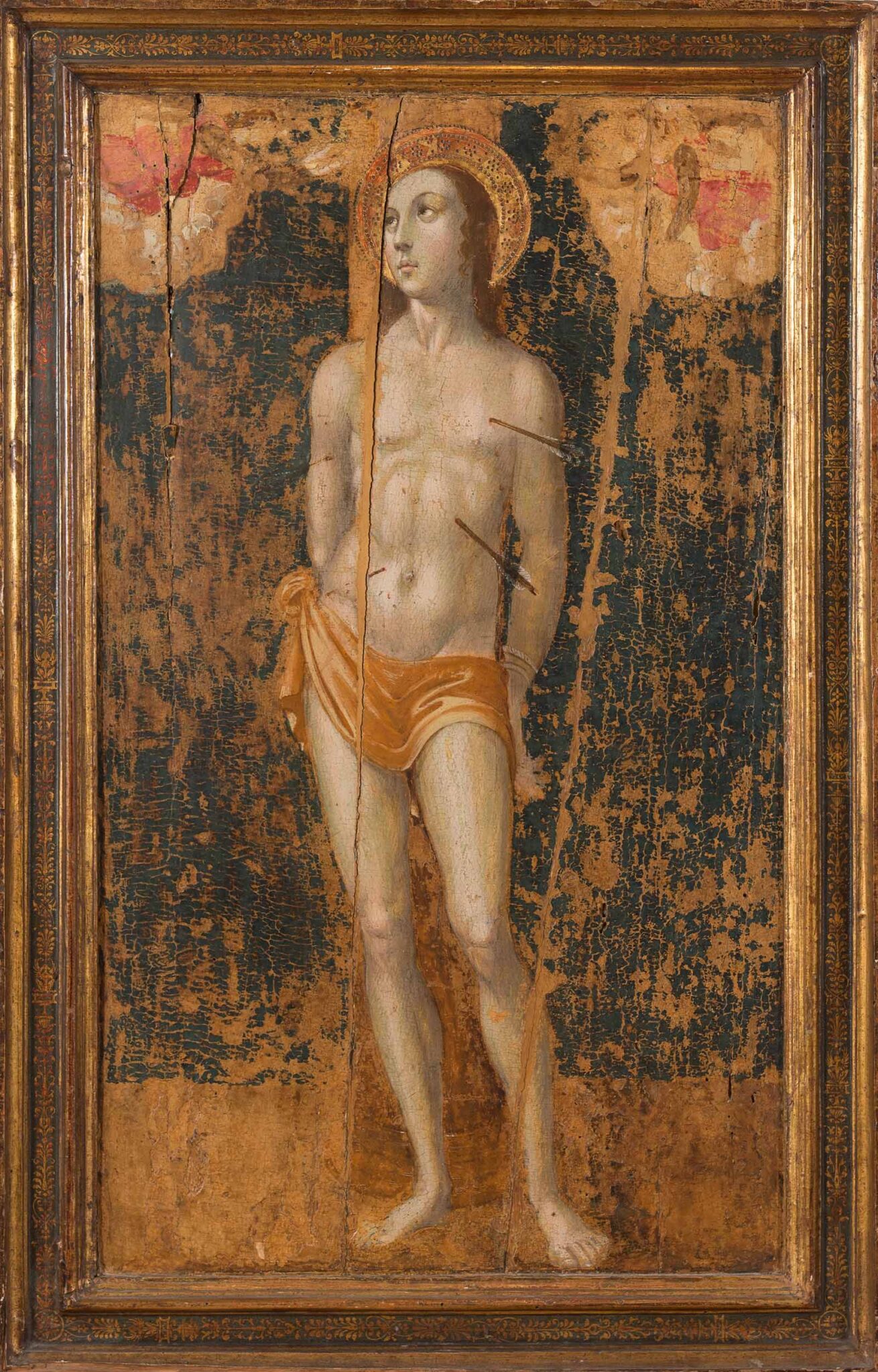
“Saint Sebastian”, attributed to Vincenzo Tamagni, belongs to the context of early 16th-century Italian painting, during a period of transition between the Late Gothic tradition and the fully developed language of the Renaissance. Tamagni, an artist originally from San Gimignano who was also active in Rome, was close to Raphael’s circle and developed a style characterised by compositional balance, formal clarity and chromatic delicacy.
In this work, the saint is depicted according to traditional iconography: young, semi-nude, bound to a tree trunk and pierced by the arrows of his martyrdom. However, the scene does not emphasise the violence of the episode. On the contrary, the figure appears composed and silent, with his gaze turned to the side and an expression of serene acceptance. This choice gives the image a devotional character that is more meditative than dramatic.
Furthermore, the gold background, marked by the passage of time, evokes a figurative culture still linked to the medieval tradition, while the anatomical rendering of the body and the softness of the modelling indicate a fully Renaissance sensibility. The contrast between the light figure and the dark-gold background accentuates the saint’s presence and focuses attention on his spiritual dimension.
“Saint Sebastian” is a work of particular interest for its ability to combine devotion, formal elegance and the legacy of early painting, placing it within a context consistent with the artistic culture of Vincenzo Tamagni.
Description: Oil on panel, H 80.5 × 50.5 cm.
Hammer Price: € 8.000,30
Explore all the top lots from our Old Masters auctions!
Do you own a work by Vincenzo Tamagni? Request a free valuation now!
Contact us: